
From an approved topic to papers worth reading.
You have finally settled on a research topic. Your supervisor has accepted it, or at least asked you to develop it. You open Google Scholar, paste the whole title, and wait. A few unrelated results appear. Perhaps nothing appears at all.
That does not mean your topic is bad. It usually means your title is doing a different job from a search query. A title describes your particular project. A useful search identifies the ideas that connect your project to work other researchers have already done.
Let us work through that difference with a qualitative topic at the meeting point of media, politics, and sociology.
Our example: political talk, trust, and belonging
How young adults in Accra interpret political claims encountered on radio and WhatsApp: a qualitative study of trust, peer influence, and political belonging.
This is a proposed teaching example, not the title of a completed study. Its central concern is how people make sense of information: who they believe, what happens when friends disagree, and how social relationships shape those judgements. That makes interviews or carefully facilitated group discussions plausible options. The final design still needs to follow the research questions.
A workable question might be: How do young adults describe deciding whether a political claim shared in a WhatsApp group is credible when it differs from what they heard on radio? Notice that we are asking about interpretation and experience. We are not promising to measure the effect of WhatsApp on every young person's vote.
Step 1: Pull out the ideas, not every word
Open a notebook or a blank document. Write the topic at the top, then underline the parts you would struggle to explain without reading. For this topic, I would start with the following groups.
Part of the topic | Useful starting terms | What that group helps you find |
|---|---|---|
Media and political content | WhatsApp; radio; political discussion; political communication | Where political information circulates |
Trust and interpretation | credibility; trust; meaning-making; interpretation | How people decide what to believe |
Social relationships | peer influence; social identity; belonging; group norms | Why friendship and group membership may matter |
People and place | young adults; youth; Ghana; Accra | Studies closer to your intended participants |
Possible methods | qualitative; interviews; focus groups; ethnography | Examples of how similar questions were investigated |
These terms are not interchangeable. A paper about misinformation may help you understand credibility, but misinformation is not a synonym for political discussion. A paper about political participation may illuminate belonging without directly studying it. Keep those distinctions in your notes.
Step 2: Make the first Scholar search deliberately simple
Open Google Scholar.
Click the search box.
Type
WhatsApp political communication Ghana.Press Enter or select the search button.
Scan titles and short descriptions for the concepts you recognised in Step 1.
Try this first search in Scholar.
I have left out Accra, young adults, trust, radio, and qualitative at this stage. Adding every condition would make it harder to discover the vocabulary used in this field. You can tighten the search after you understand what is coming back.
Also, do not judge success by a result count. What matters is whether you can identify promising titles and explain why they matter to your question.
Step 3: Build a small search ladder
Run these searches separately. Change one idea at a time so you can see what each change contributes.
Search to try | Why I would try it | Open it |
|---|---|---|
| Map the broader conversation | |
| Look for accounts of experience and interaction | |
| Search the radio side separately | |
| Move towards the question of trust | |
| Explore the sociological dimension |
Quotation marks keep the enclosed words together as a phrase. Use them for a concept such as "political identity", rather than putting your entire research title inside one pair of quotation marks. If the phrase search becomes too narrow, remove the marks or try a different term. The UC Santa Cruz Library's advanced-search guide explains phrase searching and the search form.
Step 4: Know what to inspect under a result
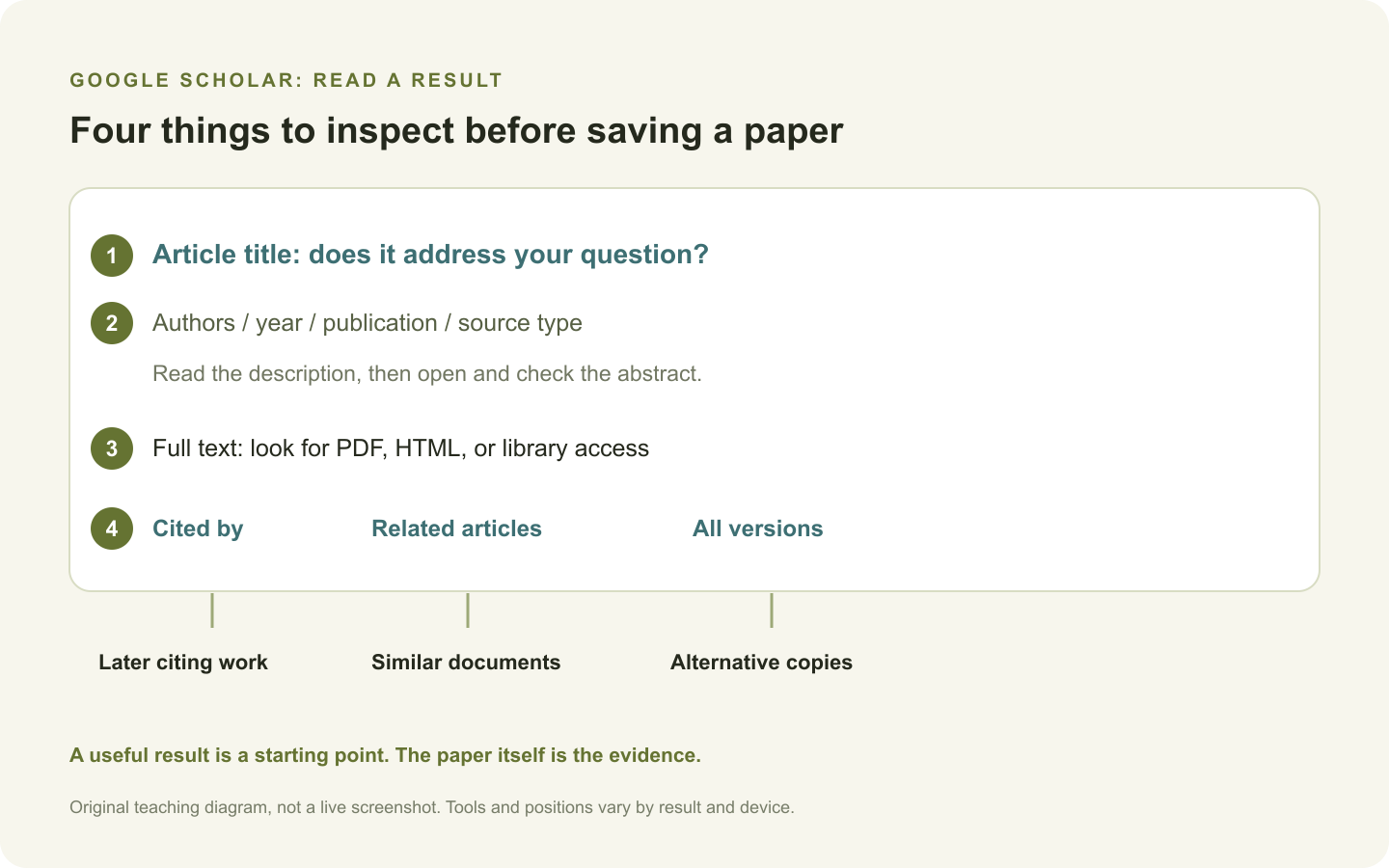
Original teaching diagram, not a live Scholar screenshot. Available links and their positions can vary by result and screen size.
Read the title, author details, year, and publication before opening a result. Use a PDF or HTML access link when available. If the main link requires payment, check alternative versions or your institution's library access. Scholar also provides Cited by and Related articles links to extend a promising lead. These features are documented in Google Scholar's search help.
The title is a lead, not a decision. Open the paper or its publisher record and check the abstract. Ask yourself: Is this about political information? Whose experiences are represented? Does it address interpretation, credibility, or social interaction?
Step 5: Practise with two real starting papers
A paper for understanding the Ghanaian media setting
Search for Newspaper Review Show in the Broadcast Media Space in Ghana: An Exploratory Qualitative Study, by Jacob Nyarko (2016).
The study used interviews with 15 purposively selected media practitioners in Greater Accra. It examines newspaper-review broadcasts and their implications for the print-media industry. For our project, it is a useful example of qualitative inquiry into Ghana's media environment. It does not provide direct evidence about young adults' WhatsApp conversations. That is an important boundary, not a reason to discard it. See the original article.
A paper for developing a conceptual conversation
Try Ghana's democracy and the digital public sphere: some pertinent issues, by Maame Adwoa Gyekye-Jandoh and Abdul Hakim Ahmed (2023).
This paper examines digital media and Ghanaian democracy through a public-sphere perspective using existing sources. It can help you consider participation and unequal access to public discussion. It is not an interview study of the group in our proposed topic. Read the published paper before deciding how that perspective fits your question.
Step 6: Read for relevance before downloading everything
For each promising paper, make a short note with five lines:
Question: What exactly did the researchers want to understand?
Participants and setting: Who spoke, and where?
Method: Interviews, observations, focus groups, document analysis, or something else?
Useful contribution: Which idea or finding speaks to my own question?
Boundary: What would it be wrong to claim this paper establishes?
If I were you, I would read one promising paper properly before opening another twenty tabs. A methods section can reveal useful search terms that the abstract never mentioned: audience reception, everyday political talk, interpretive communities, or mediated participation. Use those terms only after checking what they mean.
Do not exclude a paper simply because it uses a survey. A survey may offer valuable context, while an interview study may teach you more about how to ask a question. The method helps you understand a paper's contribution; it should not become a blind search restriction.
Step 7: Broaden the setting before abandoning the question
If Ghana-specific results are sparse, try WhatsApp political discussion "West Africa", then WhatsApp political trust youth. Keep a separate note explaining which findings come from Ghana and which come from other settings. A study elsewhere can inform an idea without proving that the same pattern exists in Accra.
For newer evidence, apply a recent-year filter while retaining relevant foundational work. On smaller screens, year controls may appear in a menu rather than a sidebar. A practical starting window in October 2026 is 2021 onwards, but your department's guidance and your subject should determine the final range. Filtering is a way to search, not a rule that older research has no value.
Step 8: Leave a trail you can return to
Create folders such as 01_To_screen, 02_Read, and 03_Set_aside. Name a saved file clearly: Nyarko_2016_Newspaper_review_Ghana.pdf. Record the full citation and the publisher link immediately. If a citation tool supplies the reference, compare it with the paper's first page before trusting it.
Keep a search log too. A useful entry says: 15 October 2026; Google Scholar; radio political discussion Ghana qualitative; retained a paper for media context; still need audience-level evidence about credibility. This is a record of your decision, not a claim about a fixed number of results.
What should you have by the end?
You should have a few well-understood papers, a better keyword list, and a clear account of what remains unanswered. You should be able to say, “This source explains the media setting; this one helps me think about trust; I still need evidence about how young adults negotiate disagreement.” That is much more useful than a folder containing fifty unread PDFs.
Next, put those reading notes into a literature matrix. If your topic tests relationships between variables, use the quantitative search walkthrough. For a developing Ghanaian policy issue, see the mixed-methods guide.
Sources and checking: Scholar features were checked against Google's documentation and the UC Santa Cruz Library guide on 15 October 2026. The two linked research papers are real sources; the proposed topic and search exercises are original teaching examples. Search results change.