
Finding evidence for a topic with an independent variable, a dependent variable, and a moderator.
A quantitative topic can sound wonderfully complete on paper. You have a leadership style, an outcome, a moderator, and a location. Then you search the title and discover that almost nobody has used that exact combination.
That is normal. Your literature search needs to investigate the pieces of the model and the relationships between them. Let us do that without turning every vaguely related leadership paper into “support” for our topic.
The topic we will work with
Transformational leadership and employee voice among staff of selected private hospitals in Greater Accra: the moderating role of psychological safety.
This is a proposed research topic for demonstration. It is not a claim that this relationship has already been established in Ghanaian private hospitals.
In ordinary language, we want to investigate whether employees who perceive more transformational leadership also report more willingness to offer constructive suggestions, and whether that association differs according to how safe they feel speaking up.
Step 1: Name the three variables precisely
Role | Our variable | What we need to understand |
|---|---|---|
Independent variable, X | Transformational leadership | How this leadership construct is defined and measured |
Dependent variable, Y | Employee voice | What counts as constructive speaking up, rather than general satisfaction or attendance |
Moderator, W | Psychological safety | Why the X-Y relationship might vary at different levels of perceived safety |
Study boundary | Staff in selected private hospitals in Greater Accra | Which institutions, staff groups, and organisational conditions the study covers |
A moderator asks “when, or for whom, is the relationship different?” A mediator asks about a pathway through which a relationship may operate. Those are different questions. You cannot rename one as the other because “moderating role” sounds more sophisticated.
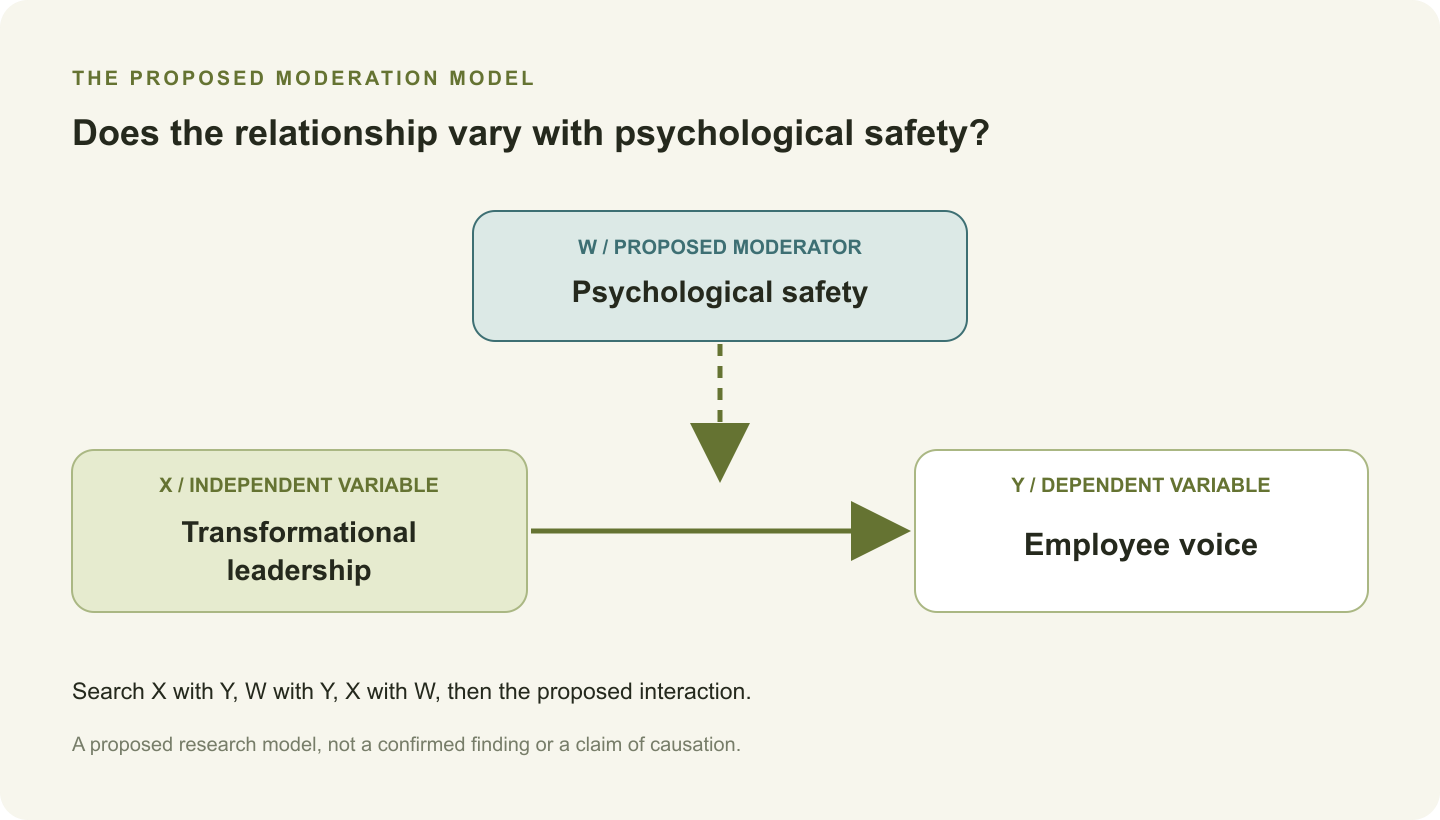
This diagram states a proposed model. It does not report a research finding.
Step 2: Search the main relationship before adding the moderator
Go to Google Scholar. Click the search field and enter:
"transformational leadership" "employee voice"Run this search. Leave Ghana, hospitals, and psychological safety out for the moment. You are first asking whether the two central constructs have been studied together.
Open a promising title. Read its abstract, identify the leadership construct, and check what the authors mean by voice. A paper about organisational citizenship behaviour may be adjacent to your topic, but it is not automatically a study of employee voice.
The keyword approach follows a useful principle in the Cornell University Library literature-search guide: reduce a research question to its core concepts and keep a record of the search strategy. The particular searches here are worked examples for our model.
Step 3: Investigate each relationship separately
Question for the literature | Copyable search | Try it |
|---|---|---|
Has X been linked to Y? |
| |
How has safety been linked to voice? |
| |
What connects leadership and safety? |
| |
Has the proposed interaction been considered? |
|
Run a second version of the last search with interaction in place of moderation. Run another without either word. Authors do not always use the same label in titles and abstracts. This is why one unsuccessful search cannot establish a research gap.
Keep “leadership,” “transformational leadership,” and “managerial openness” in different concept notes. They may be related, but they are not interchangeable measurements of the same thing.
Step 4: Use a real paper to challenge your first assumption
Search this exact title in quotation marks:
"Leadership Behavior and Employee Voice: Is the Door Really Open?"Find the paper in Scholar, then check the original Academy of Management Journal record.
Detert and Burris (2007) studied transformational leadership, managerial openness, and improvement-oriented voice. Their two-phase research involved 3,149 employees and 223 managers in a restaurant chain. Managerial openness related more consistently to voice, and psychological safety mediated that relationship.
For our example, the important point is that this paper does not establish psychological safety as the moderator in our proposed hospital model. It gives us a closely related alternative explanation to investigate. Write that distinction into your notes before it disappears under a vague sentence such as “leadership improves voice.”
Step 5: Find the foundations of your moderator
Search for Amy Edmondson's 1999 paper, Psychological Safety and Learning Behavior in Work Teams. An author-deposited version is available through Harvard's repository.
The study examines team psychological safety and learning in 51 manufacturing work teams. It is useful for understanding the construct, but its outcome and setting differ from our proposed employee-voice study. In particular, a team-level construct needs careful handling if you plan to measure individual employees' perceptions.
This is where I would slow down. Before copying questionnaire items, check the original scale, the response options, the level of analysis, and any permission or licensing requirements. A scale does not become valid for your population simply because it has been used before.
Step 6: Bring the hospital and Ghanaian context back in
Now try these searches individually:
"transformational leadership" "employee voice" Ghana"psychological safety" speaking up hospitals Ghanaleadership "employee voice" healthcare Africa
If you find little, search hospitals without Ghana, then Ghana without hospitals. Keep separate evidence folders for the relationship, the constructs and measures, and the local setting. You need all three, but one paper does not have to do every job.
One useful healthcare starting point is Nembhard and Edmondson's 2006 study of leader inclusiveness, professional status, and psychological safety. Its survey covered 23 neonatal intensive care units. Notice that leader inclusiveness is not our transformational-leadership variable. Use it to examine related reasoning and the healthcare setting, then look for evidence closer to the precise model.
Step 7: Screen the methods, not only the conclusion
When a paper looks useful, inspect its methods and results with these questions beside you.
Inspect | What to record |
|---|---|
Design and timing | Were all measures collected at one time, or across several waves? |
Who reported what? | Did staff rate both leadership and their own voice? Were supervisor ratings or other records used? |
Measures | Scale source, item count, response format, and evidence of reliability and validity in that study |
Model | Direct relationship, mediation, moderation, or a combination? |
Result | Direction, effect estimate, uncertainty, and whether the proposed interaction was actually tested |
Limits for our project | Differences in sector, country, staff group, design, or level of analysis |
Do not fill these cells from a Scholar snippet. If you have only read the abstract, write abstract screened; methods not yet checked. An honest incomplete note is better than a confident invented one.
Step 8: Understand what moderation would require
In a simple regression framework, the proposed relationship can be written as:
Employee voice = b0 + b1X + b2W + b3(X × W) + error

X = transformational leadership
W = psychological safety
The interaction term, X × W, is what allows the estimated X-Y relationship to vary with W. Finding that leadership and safety each have a separate association with voice is not, by itself, evidence of moderation.
The final analysis may need controls, a different model, or attention to employees nested within hospitals or teams. Sample size should follow the planned analysis and an appropriate power assessment, not a number copied from a convenient paper. A one-time observational survey also cannot, on its own, establish that leadership caused the outcome.
You do not need to settle every analysis decision today. You do need to search for papers that can help you make those decisions honestly.
Step 9: Use Scholar to follow a strong lead
Take a relevant paper and inspect its reference list for earlier work. On its Scholar entry, use Cited by to explore later work and Related articles to find neighbouring studies. A recent-year filter can help you update older foundational reading. Check available full-text or alternative-version links before assuming a paper is inaccessible. See Google Scholar's documentation.
Keep a note of why you followed each lead. “Cites Edmondson” is not sufficient. “Uses a clearly described measure of employee voice in a hospital setting” is much more useful.
Step 10: Write a gap you can defend
A cautious provisional statement would be:
The literature reviewed so far links leadership, psychological safety, and speaking up in several settings. However, the proposed moderating role of psychological safety in the transformational-leadership and employee-voice relationship among staff in selected private hospitals in Greater Accra still needs to be established through a fuller search and theoretical justification.
That is a planning statement, not a final claim of novelty. “No study has ever examined this” would require much stronger evidence than a short Scholar session. Extend your search through your library's subject databases and discuss the proposed moderator with your supervisor.
If I were you, I would finish this session with a clear decision: keep the proposed model because you can justify it, revise it because the literature suggests a better question, or pause while you search further. Finding a reason to improve a topic is progress.
Carry the papers into the literature-matrix walkthrough. For a topic about people's meanings and experiences, use the qualitative guide; for a policy question requiring both numbers and explanations, use the mixed-methods guide.
Sources and checking: The linked original studies and repository record were checked on 15 October 2026. Search terms, the Ghanaian hospital topic, and the proposed model are teaching examples. The cited studies do not validate that model or supply findings about the proposed Ghanaian sample.