
Turning papers from Google Scholar into an organised, critical literature review.
You have a topic and a folder of papers. Now comes the part that often causes more trouble than the search: remembering what each paper contributes and explaining how the papers relate to one another.
If every paragraph in your draft begins with an author's name and ends with “the study recommended further research,” you probably need a better reading system. A literature matrix gives you one. It helps you move from collecting PDFs to making a supported argument.
What is a literature matrix?
It is a table that asks the same useful questions of every source you read. Each row represents a source. The columns capture information such as its purpose, setting, method, findings, and relevance to your own question.
There is no single compulsory format. A leadership survey and a qualitative audience study will not need identical columns. Start with a structure that fits your question, then refine it. The aim is to see patterns without losing the evidence behind them.
The University of the Sunshine Coast's literature-grid guide introduces this way of organising sources. Our worked example below shows how to use it for an actual research decision.
Step 1: Give the matrix a research question to serve
We will return to the quantitative example from this series:
Transformational leadership and employee voice among staff of selected private hospitals in Greater Accra: the moderating role of psychological safety.
Our immediate reading question is: What does existing evidence tell us about leadership, psychological safety, and speaking up, and what would justify treating safety as a moderator in this setting?
Keep that question above your spreadsheet. Otherwise, your matrix can become a beautifully formatted storage cupboard for information you do not need.
Step 2: Set up a manageable sheet
Open Excel or Google Sheets and create a workbook called
Leadership_Voice_Literature_Matrix.Create a sheet called
Sourcesand add the column headings below.Freeze the first row, turn on text wrapping, and add filters to the headings.
Give every source a stable identifier such as
S01,S02, andS03.Add separate sheets called
Search_LogandThemes.
You can start with the blank literature-matrix template (CSV) and compare it with the worked example (CSV). Excel and Google Sheets can open these files. Apply wrapping, filters, and column widths after import because CSV stores values, not visual formatting.
Step 3: Choose columns that earn their space
Column | What to enter | A common mistake |
|---|---|---|
Source ID and full reference | A stable label and enough bibliographic detail to identify the source | Saving only an author surname and year |
Research purpose | The specific question or relationship the source examines | Copying the whole abstract |
Setting and sample | Country or sector where stated; who or what was studied; sample size where relevant | Assuming all employees, students, or teams are comparable |
Design and analysis | How evidence was collected and analysed, with timing and level of analysis | Writing only “quantitative” or “qualitative” |
Constructs and measures | Definitions, instruments, and the roles assigned to variables | Treating a mediator as a moderator |
Relevant finding | A precise paraphrase of the result that matters to your question | Writing “positive impact” without specifying what was linked to what |
Evidence locator and reading status | Section, printed page, table, or figure; whether you checked an abstract or the full text | Inventing a page number from memory |
Limits and relevance | What the source contributes and what it cannot establish for your study | Calling every difference a research gap |
Theme and next action | A comparison tag and the next question or search the paper creates | Collecting notes without deciding what to do with them |
If your worksheet becomes unwieldy, split long notes into a separate document linked by source ID. Do not solve the problem by making the font too small to read.
Step 4: Fill one row while the paper is still open
Use Detert and Burris's 2007 leadership-and-voice paper as your first source. Start by verifying the reference on the publisher record. Then work through the paper rather than extracting every sentence in order.
Read the abstract for the question. Write a short purpose statement in your own words.
Find the methods. Identify the respondents, timing, measures, and analysis. If you cannot access them yet, mark the cells not checked.
Read the results that answer your question. Trace the claimed relationship to its actual analysis rather than relying on a broad conclusion.
Record the locator. Distinguish a printed page number from a PDF viewer's page count. An abstract-only note can simply say publisher abstract.
Write your own relevance judgement. Explain what this source changes about your planned study.
For this source, “psychological safety is treated as a mediator in the relevant relationship” is a useful note. “This confirms my moderator” is not. The second statement would conceal the very issue the literature needs you to think through.
Step 5: Compare three real sources
The compact matrix below uses verified source records and abstracts. It demonstrates an initial screening matrix, not a completed full-text extraction. Detailed measures, coefficients, and page locators still need to be checked in the papers. The final column contains our judgement about fit, not a quotation from the authors.
Source | Setting and design | Relevant contribution | Boundary for our proposed topic |
|---|---|---|---|
S01: Edmondson (1999) | 51 manufacturing work teams; team-level study | Links team psychological safety with learning behaviour | Learning is not the same outcome as individual employee voice; do not transfer the level of analysis silently |
S02: Detert and Burris (2007) | Two-phase restaurant-chain study | Connects managerial openness, psychological safety, and voice through a mediation account | Does not establish the proposed safety moderator among staff in Ghanaian private hospitals |
S03: Nembhard and Edmondson (2006) | Survey in 23 neonatal intensive care units | Examines leader inclusiveness, status, safety, and improvement work | A healthcare comparison; inclusiveness differs from transformational leadership |
Sources: S01, Harvard repository; S02, Academy of Management Journal; S03, Journal of Organizational Behavior.
Notice what this table already does for us. It separates outcomes, sectors, and the roles assigned to constructs. We now have specific questions for the next search, instead of a general feeling that “more literature is needed.”
Step 6: Distinguish a source's limits from your own inference
Keep two kinds of note visibly separate:
Author-reported limitation: a limitation the paper itself identifies, with a locator.
My assessment of fit: a reason the paper does or does not answer my question.
A manufacturing setting is not automatically a flaw in a study designed to understand manufacturing teams. It is a boundary when you want to apply that study to hospital employees. That distinction makes your criticism more accurate and more respectful.
Likewise, “not conducted in Ghana” does not automatically establish a worthwhile gap. Explain why the Ghanaian setting could change the question: professional hierarchy, institutional arrangements, or another reason your reading can support.
Step 7: Create a small synthesis matrix beside the extraction matrix
The first matrix tells you what each source contains. A synthesis matrix helps you compare sources around a question. Create your Themes sheet with one row per theme or debate.
Theme or question | Sources to compare | What we still need |
|---|---|---|
What does safety enable? | S01, S02, S03 | Compare the actual outcomes and avoid presenting learning, voice, and improvement as identical |
What kind of leadership is being examined? | S02, S03 | Clear definitions and evidence closer to transformational leadership |
Is safety a pathway or a condition? | S02, followed by further searching | A theoretical and empirical basis for moderation, rather than a relabelled mediation model |
How close is the setting to our project? | S03, followed by Ghanaian sources | Evidence about the relevant hospitals, staff groups, and institutional conditions |
If I were you, I would start with three or four useful themes and allow them to change. A heading called “Other studies” is usually a sign that the comparison question is still unclear.
Step 8: Turn the table into a paragraph with an argument
Here is a short synthesis based on the initial matrix:
Psychological safety connects these studies, but their outcomes and leadership constructs differ. Edmondson (1999) examines learning in teams, whereas Detert and Burris (2007) address leadership and employee voice. Nembhard and Edmondson (2006) add a healthcare setting and a focus on leader inclusiveness. Together, these sources give a starting point for examining speaking up at work, but they do not settle the proposed moderating role of safety in the Ghanaian hospital topic.
The paragraph makes a comparison and explains its significance. It does not pretend the three sources tested the same model. A fuller review would need additional evidence, detailed methods checking, and engagement with contradictory findings.
This move from summary towards comparison is central to literature-review writing. The University of Southern California's literature-review guide explains the distinction between summarising sources and synthesising them in relation to a research problem.
Step 9: Adapt the matrix to qualitative and mixed-methods work
For the media-and-politics topic
Add columns for participant perspectives, sampling rationale, interview or observation approach, analysis, and relevant social context. Ask whose experiences are missing. Preserve the difference between participants' accounts and the researcher's interpretation. If you record a quotation, use quotation marks and a page or section locator; do not present it as your own paraphrase.
For the No Fees Stress topic
Add source type, policy component, academic year, and integration approach. Keep official policy documents identifiable. A policy document may have not applicable under sample and statistical analysis, while an abstract-only empirical source may have not checked. Those labels mean different things.
For a mixed-methods paper, record how the strands were connected and what was learned from bringing them together. “Questionnaire plus interviews” is too thin a description to help you design your own study.
Step 10: Maintain the matrix as you read
Keep a reading status. Use labels such as abstract screened, full text read, measures checked, and set aside.
Keep duplicates out. A repository version and a publisher version of the same paper usually belong to one source record.
Keep the evidence accessible. Store the DOI or stable link and a clear filename.
Use your own words carefully. Paraphrase from understanding, then check accuracy against the source.
Leave uncertainty visible. Write not reported, not checked, or not applicable where appropriate.
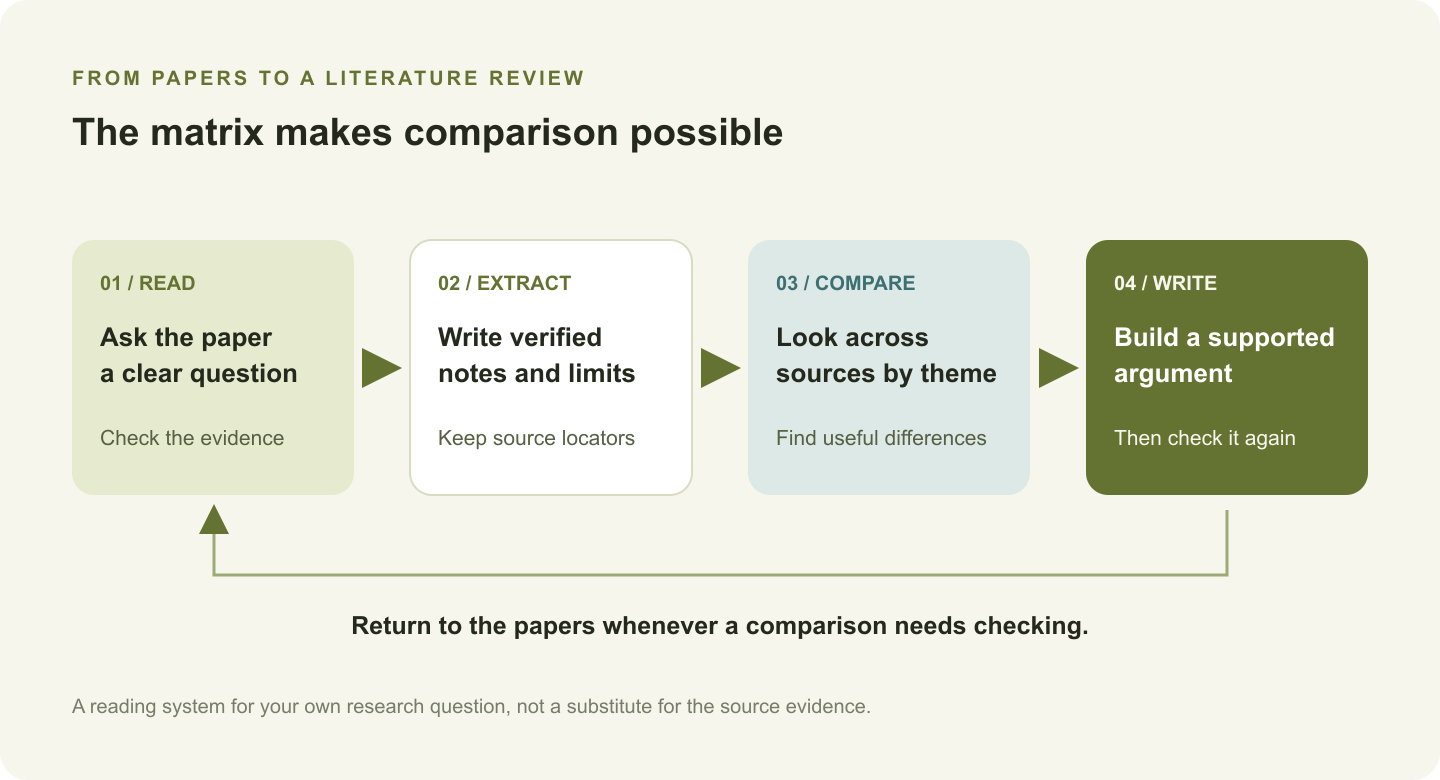
Return to the papers. The matrix organises your reading; it does not replace the original evidence.
A useful stopping point for today's session
Read a few sources carefully, complete the fields you can verify, and identify one comparison that changes how you see your topic. Then write one short paragraph from that comparison. You do not have to fill an entire spreadsheet before you begin thinking.
Start with the blank CSV template, compare the screened example, and keep refining both your search and your question.
Return to the search guide that fits your work: qualitative media and politics, quantitative leadership and moderation, or mixed methods and Ghana's No Fees Stress initiative.
Sources and checking: Research records and the linked university guidance were checked on 15 October 2026. The table and downloadable example intentionally identify abstract-level screening. They are not represented as completed full-text reviews. The proposed topic, evaluation notes, template, and synthesis paragraph were created for this guide.