
Searching a current Ghanaian issue when you need both numerical evidence and people's explanations.
A new policy can make an excellent research topic, but it creates an awkward starting point. Everybody seems to be discussing it, yet Google Scholar may return very little under the policy's exact name.
Do not respond by turning news reports into research papers, and do not abandon the topic immediately. Separate what you need to know about the policy from what you need to learn from the wider literature. We will use Ghana's No Fees Stress initiative to show how that works.
Our proposed topic
Financial strain and academic participation among first-year undergraduates at selected public tertiary institutions in Greater Accra under the No-Academic-Fees component of Ghana's No Fees Stress initiative: an explanatory sequential mixed-methods study of the 2025/26 cohort.
It is a substantial title, but each boundary matters. We have named the component, the students, the setting, and the academic year. We are proposing an inquiry, not reporting that the initiative has reduced financial strain or improved participation.
Step 1: Establish what the policy actually covers
Before Scholar, read the responsible institution's documents. The Students Loan Trust Fund's statement of 20 August 2026 describes No Fees Stress as several interventions. Our example focuses on the No-Academic-Fees component for first-year students in public tertiary institutions. The statement also distinguishes reimbursement and direct-to-institution implementation arrangements.
Check the SLTF reimbursement guide for the named academic year and institution or programme. Record the document date and the date you accessed it. Academic-fee support should not be assumed to cover every living cost or every student group.
That short policy check changes your research. Accommodation, transport, food, devices, and the timing of support could still matter to a student's financial circumstances. Those are possible questions to investigate, not findings we can attribute to the policy without data.
Step 2: Turn the topic into three connected questions
Part of the study | A question we could investigate | Evidence to search for |
|---|---|---|
Quantitative | How do reported financial strain and academic participation vary across students with different support experiences? | Measures of financial strain, participation, and student support |
Qualitative | How do students explain the financial pressures and support experiences behind those patterns? | Interviews about costs, timing, coping, and academic decisions |
Integration | How do the interviews help explain the survey patterns, including cases that do not fit the expected pattern? | Examples of connecting a survey phase to a later interview phase |
For this example, define academic participation before collecting data. It might include class attendance, access to required learning materials, or participation in academic activities. It is not automatically the same as examination performance. Your measures must match your definition.
“Explanatory sequential” means that you analyse the quantitative phase first, then use it to inform the qualitative phase. The two phases must connect. Simply collecting a questionnaire and some interviews does not explain why the study needs mixed methods. Fetters, Curry, and Creswell (2013) provide a useful account of integration in mixed-methods designs.
Step 3: Extract keywords in layers
Layer | Starting terms | Why keep it separate? |
|---|---|---|
Policy name | No Fees Stress; No-Fees-Stress; No-Academic-Fees | Find work explicitly about this intervention |
Policy mechanism | fee support; tuition assistance; fee reimbursement; student financial aid | Find comparable research using other labels |
Student experience | financial strain; financial stress; financial hardship; cost of living | Find concepts and potential measures |
Academic participation | attendance; engagement; participation; learning materials | Explore outcomes that require distinct definitions |
Context and design | Ghana; public universities; first-year; mixed methods; explanatory sequential | Find local context and design examples |
“Financial strain,” “financial stress,” and “financial hardship” may overlap, but authors can define them differently. “Tuition-free” policies elsewhere may also cover different charges from Ghana's academic-fee component. Search these terms, then compare their definitions rather than silently treating them as equivalent.
Step 4: Search the exact policy, then broaden on purpose
Open Google Scholar, click the search field, and try the first two searches below separately. Then move down the table.
Search | What you are trying to learn | Open it |
|---|---|---|
| What scholarly work uses the public-facing name? | |
| What uses the name of the specific component? | |
| What is known about tertiary student support locally? | |
| How have financial pressures been investigated? | |
| What evidence and measures might inform our outcome? | |
| What can comparable policy settings teach us? |
Some searches may return little. That is information about the query and the available index, not proof that nobody has studied the problem. Try spelling variations, remove one condition, inspect university repositories, and ask your librarian about relevant databases.
If I were you, I would keep three folders from the start: Policy documents, Empirical studies, and Methods. Otherwise, a useful press statement can quietly become a supposed research finding by the time you write Chapter Two.
Step 5: Search the two strands separately
For the survey strand
Try "financial stress" university students scale and financial hardship attendance university students Ghana. Read for definitions, measurement choices, sampling, timing, and plausible alternative explanations.
You are not shopping for a questionnaire to copy. You are deciding which questions and measures can answer your question. Check whether an instrument measures anxiety about money, actual difficulty meeting expenses, or both. Those can lead to different interpretations.
For the interview strand
Try student financial aid Ghana qualitative interviews and "university students" financial hardship experiences Africa. Look for the situations interviews reveal: choosing between transport and meals, seeking help, waiting for support, or missing an activity because of a cost.
Do not put those experiences into participants' mouths. They are possible areas to explore if supported by your reading and approved research questions. An interview question such as “Tell me about a recent occasion when a study-related cost affected your plans” is less leading than “How has the policy failed to solve your financial problems?”
Step 6: Find a design paper and explain the connection
Search Achieving Integration in Mixed Methods Designs - Principles and Practices. The paper by Fetters, Curry, and Creswell explains ways of connecting and integrating qualitative and quantitative work. It is a methods source, not evidence about Ghana's fee policy.
Here is how we could apply the design to our proposed study:
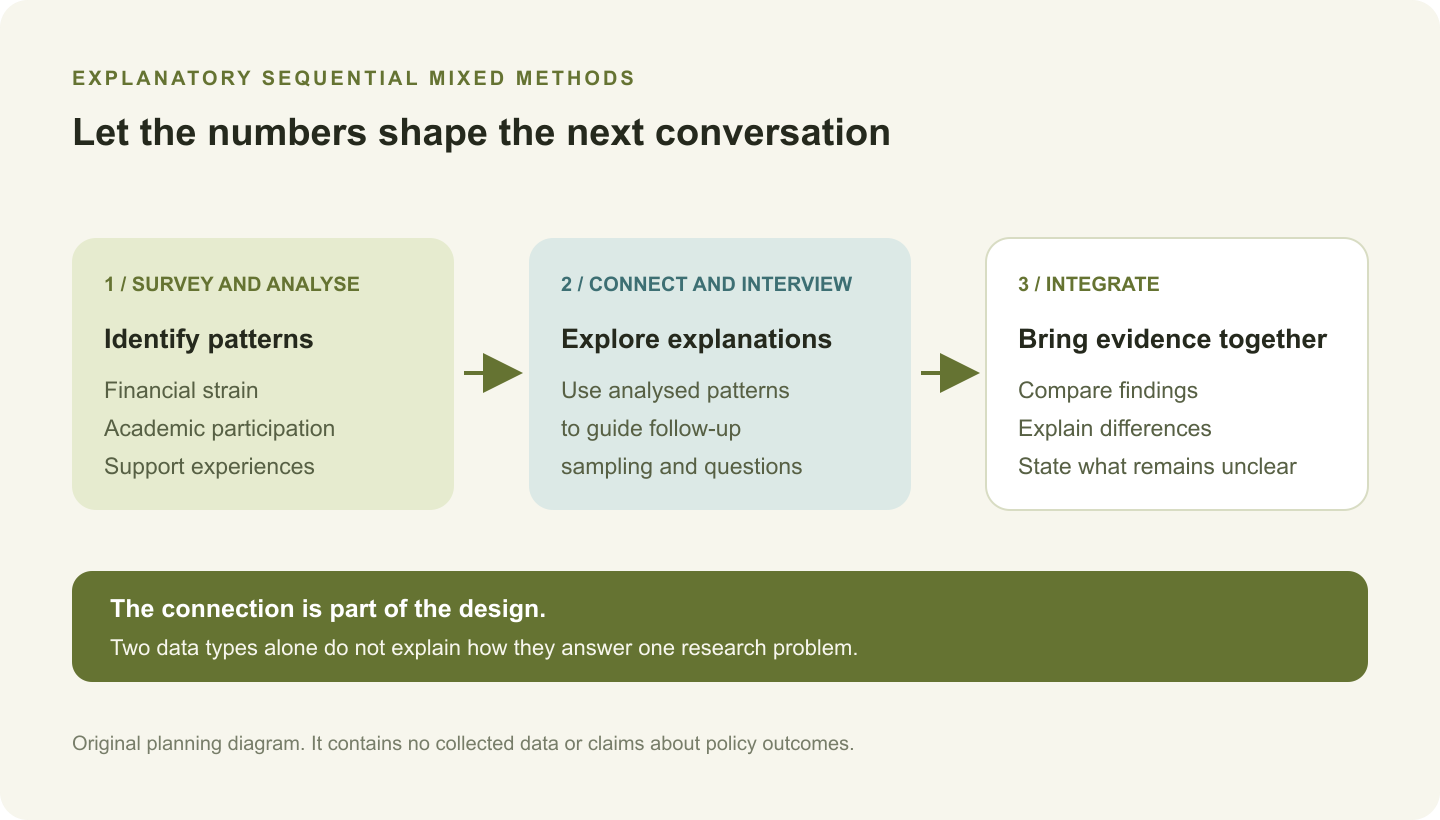
Survey: Collect relevant information on support experiences, financial strain, and clearly defined participation measures.
Analyse: Identify patterns worth explaining, including unexpected cases.
Connect: With consent and an approved sampling plan, invite interview participants whose experiences help explore those patterns.
Interview: Ask how students explain the circumstances behind the survey responses.
Integrate: Compare the numerical patterns with the explanations and identify agreement, differences, and remaining uncertainty.
Step 7: Picture what integration would look like
The following table is a planning exercise. It contains no collected data and makes no claim about actual beneficiaries.
If the survey were to show... | The interview phase could explore... | The combined interpretation would need to consider... |
|---|---|---|
Some supported students still report high financial strain | Which expenses remain difficult and when support became available | Whether the support addressed one cost while other pressures continued |
Students with similar reported strain describe different participation levels | Transport, work schedules, family support, and study arrangements | Why similar financial circumstances may not produce identical academic experiences |
Administrative support records and student recollections differ | What students understood, received, or could access at the relevant time | Differences between eligibility, recorded disbursement, and experienced benefit |
This kind of joint display helps you plan a conversation between the strands. In a completed study, you would replace these possibilities with actual analysed evidence and describe how the interpretation was reached.
Step 8: Keep description separate from causal impact
If you survey students after the initiative and ask how they feel, you cannot automatically conclude that the policy caused a change. Students may differ in household resources, employment, programme costs, and other support. Retrospective comparisons can also be affected by recall.
For a claim about impact, discuss an appropriate evaluation design with your supervisor. For our example, carefully bounded descriptions and associations, followed by explanations, may be more defensible. The word “impact” in a title does not create the evidence needed to establish it.
Step 9: Save evidence according to the job it can do
Official policy documents: establish stated coverage, implementation arrangements, and dates.
Empirical studies: report data about students, institutions, finance, or participation.
Conceptual sources: develop definitions and possible explanations.
Methods sources: help justify measurement, sampling, analysis, and integration.
A news story may help you locate a debate or a source to check. It does not substitute for a study of the policy's outcomes. Similarly, an official document is authoritative about the institution's stated arrangements, but that does not make it an independent evaluation of effectiveness.
Record the query, date, link, source type, and your reason for keeping each item. Check citation details against the original document. For a recent policy, revisit the official information before submission; do not assume an October 2026 description will remain current.
Your next useful move
Write a short evidence note: “I have established the policy component and cohort. I have started locating literature on financial strain and participation. I still need stronger local empirical evidence and an agreed plan for connecting the survey and interviews.”
Then use the literature-matrix guide to organise what you found. It will help you avoid treating policy announcements, empirical findings, and methods advice as if they were the same kind of evidence.
For the other search demonstrations, read the qualitative media-and-politics guide and the quantitative leadership guide.
Sources and checking: Policy descriptions were checked on 15 October 2026 against the linked SLTF documents. The design discussion draws on Fetters, Curry, and Creswell (2013), DOI: 10.1111/1475-6773.12117. The topic, search exercises, interview prompts, and integration table are original teaching examples. None of the suggested survey patterns is presented as an observed policy outcome.